

Why Russia Dedicated Server Hosting is Better for Your Business?
When US organizations think about overseas hosting, I often suggest that they choose a Russia dedicated server. This is especially true if Russia is on their list of expansion destinations. This tutorial explains how dedicated servers in Russia differ from other options. Additionally, we will look at what performance and legal trade-offs to expect, how to improve security, and how to choose a trustworthy supplier like OnliveServer.
Why US Companies Think About Hosting in Russia
Discover why more and more US companies are choosing to host their applications in Russia. Specifically, this choice offers great benefits such as cheaper pricing options, access to a rising tech market, and data sovereignty advantages. Furthermore, it provides significantly better performance for European and Asian consumers. Consequently, hosting here can boost your business’s online presence, lower latency, and ensure you follow local regulations seamlessly.
Less Latency for People in Russia and Nearby
Learn how hosting in Russia can greatly lower latency for people in Russia and adjacent areas. In fact, businesses can improve website load times, user experience, and overall performance for local traffic by picking servers located in the same geographic area. Moreover, putting servers in these strategic places assists clients in Eastern Europe by providing faster, more reliable network connections.
Localization and following the rules
For enterprises who host in Russia, localization and following the rules are quite important. Businesses can make sure they follow Russian data protection rules, including the necessary data localization requirements, by hosting their data in Russia. These laws say that data about Russian residents must be stored within the country’s boundaries. This not only helps businesses avoid legal problems, but it also creates confidence with local users, who are more willing to utilize services that follow the rules of the country.
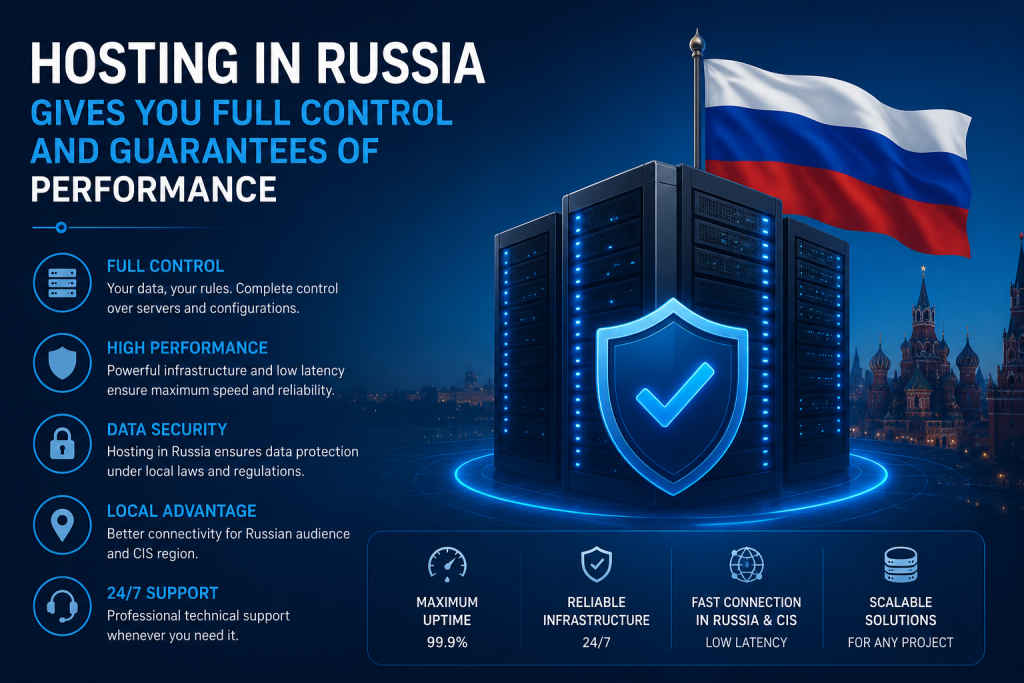
Hosting in Russia gives you full control and guarantees of performance
Businesses can get full server administration with dedicated resources and personalized VPS hosting solutions. This makes sure that the servers work at their best for their individual demands. Hosting in Russia guarantees uptime, fast load times, and great dependability, which makes it easier for businesses to grow while still being able to fully control their server settings. Find out how this control helps businesses accomplish performance goals, make the best use of their resources, and give users a smooth experience, all supported by robust service level agreements and support assurances.
Different Types of Hosting in Russia
You can choose the best technique if you know the different hosting models. I explain the many options and when each one is best.
Servers for Dedicated Use
- Physical and just one tenant. All of the gear is set aside for you to utilize, and you can count on it to work as expected.
- Best for workloads that need a lot of input and output, such gaming servers, video streaming, and databases that need to follow rules.
- Shared physical host but separate virtual environment.
- Cheaper but with a variable risk of noisy neighbors good for moderate workloads or development situations.
Peering and Network Topology
The quality of a network depends on how well the data center connects to other networks and how well it sends data upstream. Talk to possible providers about:
- Direct connections with major Russian carriers and IXPs (Internet Exchange Points).
- Guarantees of available bandwidth and port saturation.
- More than one carrier or cross-connect option to lower the danger of a single carrier failing.
Best Practices for Technical Hardening
- Make the operating system more secure by limiting services, having strong user policies, and patching quickly.
- Limit lateral movement by using firewalls and dividing your network into smaller parts.
- Use centralized logging and intrusion detection and prevention systems (IDS/IPS).
- Turn on full-disk encryption for data that isn’t being used and TLS for data that is being sent.
- Use multi-factor authentication (MFA) and role-based access control (RBAC) to control who can access administrative functions.
Things to think about from a legal and operational point of view
Hosting in Russia means that your business has to follow the laws and rules of the country. Important points:
- Data sovereignty: Some personal and business data may need to stay in the country by law.
- Access for law enforcement: Local authorities can ask for data, look at provider transparency reports, and see how law enforcement handles requests.
- Sanctions and export controls: US enterprises must follow sanctions and export rules. Before putting important services in places with complicated geopolitical risks, they should talk to a lawyer.
Certifications and compliance for security
Russia dedicated server gives organizations the benefit of being able to meet the strict security and compliance criteria that are needed for doing business there. Companies may make sure they follow Russia’s strict data protection standards, which are similar to the GDPR, by picking a Russian data centre. They can also get internationally recognized security certifications. This means following ISO standards, SOC 2, and other industry-specific certifications to make sure that your data is safe, safeguarded, and managed according to the strictest security requirements.
Checklist for Moving
To arrange a migration or deployment to a Russia dedicated server, use this list:
- Check with your lawyer to make sure you are following all the rules and laws.
- Choose a provider and a data center region in Russia that has the right peering.
- Adjust the size of the hardware based on load testing and capacity planning.
- Set up the network, firewall rules, and access control. Limit management ports and turn on MFA.
- Make backups, replicate data elsewhere, and run disaster recovery tests.
- Set up monitoring, logging, and alerting that works with your SOC.
Conclusion
For US firms that need low-latency access, compliance with regulations, or assured physical resources, hosting on a dedicated server in Russia can be a good technical and operational choice. Before you can enjoy the benefits, you need to think about the legal and political issues that come with them. If you decide to go ahead, make sure to focus on the quality of the network, security hardening, backup plans, and a supplier with a track record of working in your area. I can help you make a custom vendor comparison matrix for OnliveServer and other providers, or I can help you write a migration strategy that fits your application’s architecture and compliance needs.